

Acute care pathways are designed to address immediate clinical priorities. They stabilise, treat, and support people through the most critical phases of recovery but recovery does not end there.
As time passes, a different set of challenges begins to shape how someone is actually living day to day. These challenges are not always fully captured within standard pathways, not because they are unimportant, but because they sit outside what those pathways are designed to measure.
Over time, four key domains begin to define long-term recovery.
In most cases, long-term recovery involves multiple parties. Insurers may be involved in funding care. Rehabilitation providers deliver treatment during defined periods. Case managers coordinate elements of support. Legal teams may oversee aspects of the claim. Clinical professionals contribute their expertise at different stages.
Each plays an important role. But none of them, individually, are structured to hold the full trajectory of recovery over time. Instead, responsibility becomes distributed across the system, and in being distributed, it often becomes diluted. The result is not a lack of care, but a lack of ownership.
The Four Domains Long-Term Recovery Often Turns On
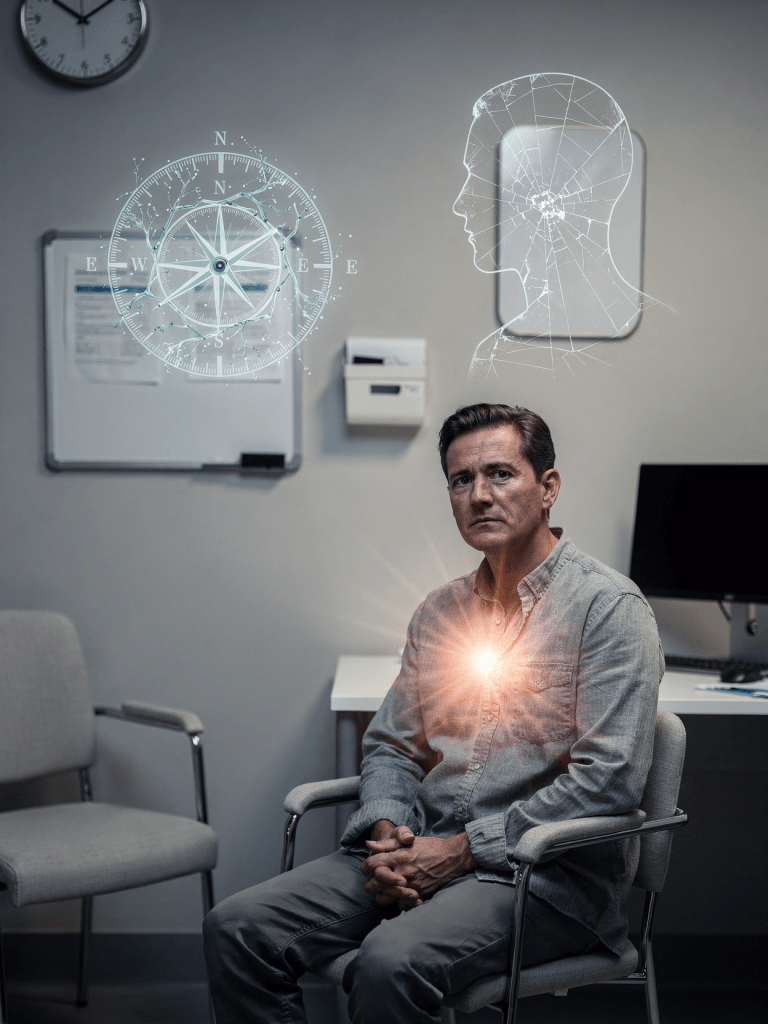
Long-term recovery is rarely shaped by pain alone. Over time, four domains often begin to define how life is actually functioning: pain, cognition, identity, and confidence. Pain may be the most visible, but cognitive fatigue, reduced concentration, and mental overload can be just as disruptive. At the same time, recovery can unsettle a person’s sense of self, affecting how they relate to work, relationships, independence, and the future. Confidence is often the last part to return, the ability to drive, socialise, commit to plans, or trust the body again. These domains overlap and influence one another, yet they are rarely held together within a single framework. As a result, someone may appear medically stable while still struggling in ways that deeply affect daily life.
What This Means for Long-Term Recovery
These four domains — pain, cognition, identity, and confidence, do not exist separately. They interact, overlap, and influence one another over time.Yet they are not always held together within a single, coherent framework.
This means that recovery can appear complete from a clinical perspective, while still feeling incomplete in everyday life.
Closing Reflection
Long-term recovery is not defined only by whether symptoms have improved. It is defined by whether life is becoming more possible again. When key parts of recovery sit outside the pathways designed to support it, progress becomes harder to see and harder to sustain.
Recognising these domains is the first step in understanding what recovery truly requires.
Discover more from Trauma Pain Support Ltd.
Subscribe to get the latest posts sent to your email.
