
May 2026 · Practitioner Briefing
What the Clinical Record May Miss: Long-Term Recovery After Serious Road Traffic Trauma
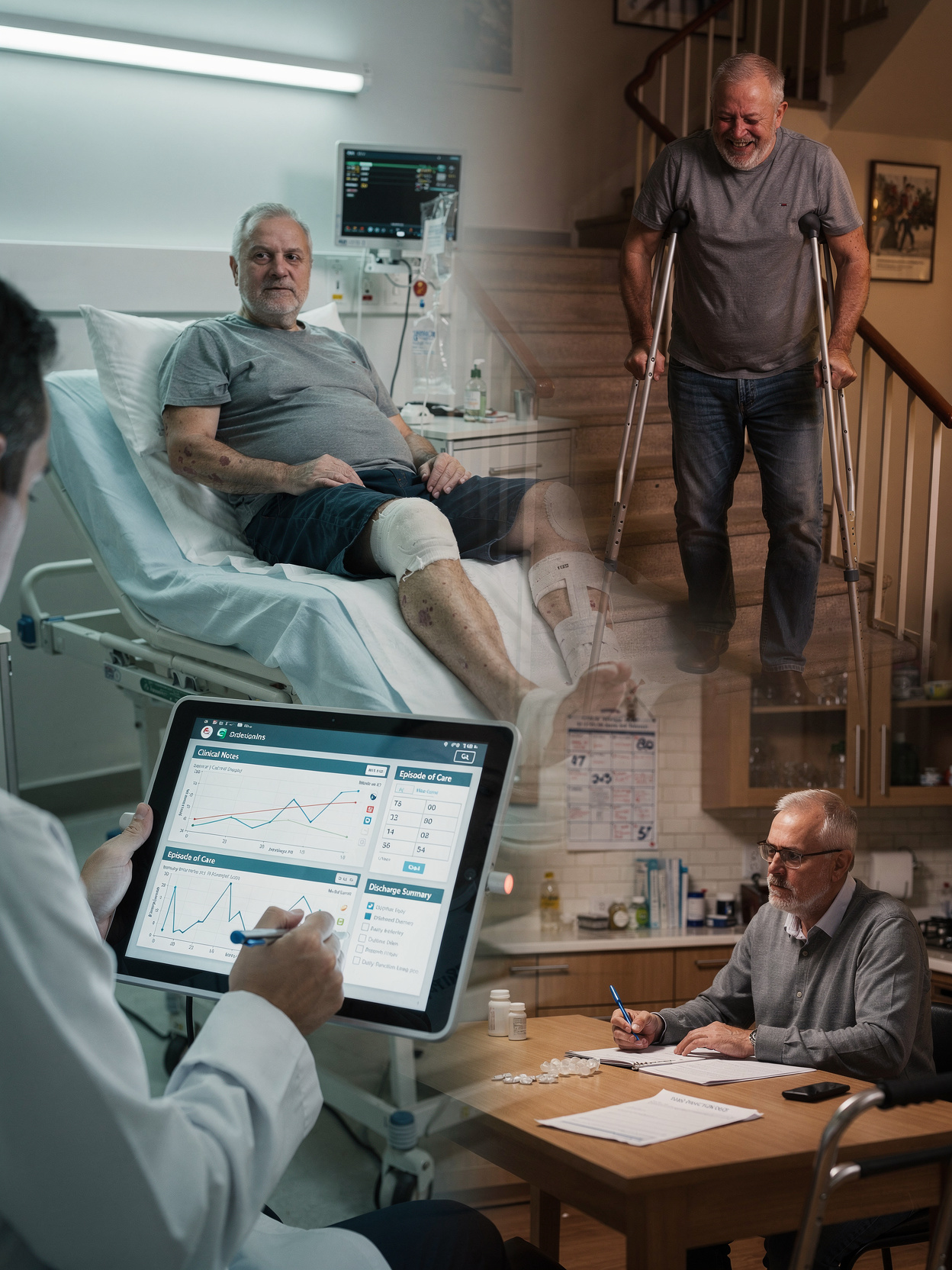
Understanding the gap between documented clinical episodes and the full recovery trajectory
Clinical records provide essential evidence during defined episodes of care. However, no single clinical encounter can fully represent daily function or how recovery changes over time. This article examines what may remain less visible when formal clinical contact reduces but the effects of serious road traffic trauma continue.
On This Page
Clinical Evidence Is Often Episode-Based
Healthcare and rehabilitation records are typically created around discrete episodes of professional contact — hospital admissions, individual consultations, formal assessments, specific interventions, defined rehabilitation programmes, and discharge or case closure. Each record may be accurate and clinically appropriate within its own context. The limitation is not the quality of individual records, but the gaps between them.
A Fragmented Picture
When a person moves between acute care, community rehabilitation, and independent management, the documented record may reflect a series of separate episodes rather than a continuous recovery journey. Each service sees its own portion of the picture.
Structural, Not Individual
This is not a criticism of individual practitioners. It is a structural feature of how post-acute pathways are typically organised. Time-limited episodes of care, separate referral systems, and distinct service boundaries mean that longitudinal continuity of evidence is rarely built into the design of the pathway.
The Gap Between Episodes
Research mapping trauma rehabilitation pathways across five UK major trauma networks found a lack of communication between acute and community care, inconsistent service provision, and waiting lists of up to twelve months for community rehabilitation — conditions in which significant recovery developments may occur without formal documentation.
The available evidence may not always capture what occurs between episodes of formal care — and it is in those intervals that some of the most consequential recovery developments may take place.
What May Be Missing Between Appointments
Absence from the clinical record does not mean absence from the survivor’s experience. A range of developments may occur in the intervals between formal appointments — developments that are real, consequential, and yet rarely captured in routine documentation.
Less Visible Developments
Why They May Go Unrecorded
Research into recovery trajectories following road traffic crash injury has identified distinct subgroups, including individuals with chronic and declining physical and mental health-related quality of life over a two-year follow-up period. A five-year follow-up study of young major trauma survivors in the UK found that only 20% reported no disability, with the most commonly encountered difficulties including behavioural, intellectual, and locomotor problems — many of which had significant impact on work and daily life. These findings suggest that the recovery period extends well beyond the timeframes typically covered by formal clinical contact.
“A person may present as managing adequately during a brief clinical encounter while simultaneously carrying a level of daily burden that is not visible within that encounter.”
The Difference Between a Clinical Snapshot and a Recovery Trajectory
A clinical appointment captures a moment. It records how a person presents, what they report, and what a practitioner observes within a defined and often brief encounter. This is valuable information — but it is not the same as a recovery trajectory.
Presentation at Appointment
How a person appears, communicates, and functions during a structured clinical encounter. May be influenced by preparation, anxiety, or the effort of attending.
Function Across a Day or Week
The person’s actual capacity to manage daily tasks, maintain routines, sustain concentration, and cope with unexpected demands across a full week at home.
Recovery Trajectory Over Months
The direction and pace of change — whether function is improving, plateauing, or declining — across the full post-acute period. This is rarely captured by any single encounter.
Research tracking health-related quality of life following road traffic crash injury over 24 months identified that a significant proportion of survivors follow trajectories of chronic or declining function — trajectories that would not be apparent from a single clinical encounter at any one point in time. Practitioners are encouraged to consider whether the evidence available to them reflects sustained real-world function, or primarily performance during brief encounters.
Implications for Clinical and Rehabilitation Decision-Making
Incomplete longitudinal evidence does not only affect clinical care. It has implications across a range of professional contexts in which decisions about a survivor’s recovery are made.
Rehabilitation Planning
There is a risk that rehabilitation goals are set on the basis of a partial recovery picture, without adequate information about how function varies across a full week or changes over time.
Clinical Review and Case Formulation
A clinical review based primarily on isolated encounters may not fully reflect how symptoms and functional demands interact across a complete day or week.
Return-to-Work Decisions
Vocational rehabilitation and return-to-work planning may rely on assessments that reflect capacity at a single point, rather than the sustained functional demands of employment. Research has found that a range of psychosocial, physical, and functional health issues persist at long-term follow-up in major trauma survivors, with significant implications for work participation.
Referral and Escalation
Changes that emerge between appointments may warrant further enquiry, review or referral where they materially affect function or recovery.
Further longitudinal examination may be needed to understand the full extent to which episode-based evidence systems affect professional decision-making across these contexts.
Strengthening Longitudinal Clinical Understanding
Strengthening the evidence base for long-term recovery after serious road traffic trauma does not require a single solution. It requires a broader professional orientation — one that values longitudinal understanding alongside episodic accuracy.
Longer-Term Follow-Up
Where appropriate, proportionate follow-up beyond the immediate post-acute period may provide a more complete understanding of recovery progress, changing function and emerging need.
Survivor-Reported Experience
Patient-reported outcome measures and survivor accounts of real-world function offer evidence that clinical observation alone cannot provide. These perspectives are particularly valuable in capturing the less visible dimensions of recovery.
Real-World Functional Information
Information about function at home, in the community and at work may complement observations made during brief clinical encounters.
Clinical Documentation Over Time
Recording clinically relevant changes across episodes of care may support a clearer longitudinal understanding of recovery.
Multidisciplinary Clinical Communication
Where several services are involved, clear communication of clinically relevant changes may help practitioners understand recovery across separate episodes of care.
Practitioner Reflection Questions
01
Does the evidence available to you show a survivor’s recovery journey over time, or mainly a series of separate clinical episodes?
02
What important changes might occur between appointments without being formally documented?
03
When making professional decisions, how much weight is placed on sustained real-world function rather than presentation during a single encounter?
04
What information would help your service understand long-term recovery more accurately?
Conclusion
A clinical record can accurately describe an episode of care without fully representing the course of recovery. The two are not the same, and conflating them may affect decisions about rehabilitation, clinical review and return to work. Strengthening clinical understanding of long-term recovery after serious road traffic trauma requires greater attention to what happens between services, between appointments and after formal rehabilitation has ended.
This article forms part of the TPS Practitioner Resource Series examining long-term post-acute recovery following serious road traffic trauma.
This article is produced by the Trauma Pain Support team for practitioner education purposes. It does not constitute clinical guidance and is not a substitute for professional judgement or medical advice.
Professional Memberships: RSM · BSPRM · VRA · SOM · UKABIF · IPIC · NICE Registered Stakeholder
Trauma Pain Support Ltd · Company No. 16408714 · Registered in England & Wales · Framework aligned with WHO Rehabilitation 2030 principles
